
10/14/2009
Serious lab for innovation: R&D at Repères receives support from the government within the framework of the plan for restarting the economy
The Repères vision is founded on designing new market research tools. It is in such a context and as an extension of our work on virtual worlds that we became interested in the Serious Game phenomenon: This type of protocol, generating excellent results in the field of teaching and training could be a solution for making our studies more participative, more involving and producing more creative results. The question is, could we invent the “Market Research Game”?
We evoked the idea of such research with Guy Parmentier from the ESC Chambéry laboratory, with whom we are collaborating in the field of the Co-designing of Virtual Worlds. Guy suggested we join a working group that happened to be forming on the subject.
With this group, composed of three companies (Sphinx Développement, Symétrix, Repères) and two research laboratories (Syscom and ESC Chambéry), we had the pleasure of being selected within the framework of a call for research-development projects by the government, within the context of the “Digital” part of the plan to restart the economy launched on 27 May last by Nathalie Kosciusko-Morizet.
Our shared project “Serious Lab for innovation” is aimed at developing a web platform making it possible to implement Serious Game principles in a market research approach.
The Serious Lab project should result in an operational prototype by the end of 2011 and will receive a global subsidy of 700 000 euros.
14:58 Posted in Co-creation, Market Research Game | Permalink | Comments (0) | Email this | Tags: serious game, serious lab
03/25/2009
Presentation of the results of the co-design initiative for CTIFL and UNFD
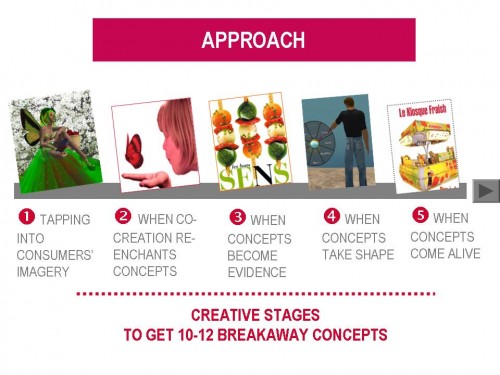
In these times of economic uncertainty, disruptive innovation is increasingly essential for creating a competitive edge. At Repères we are convinced that innovation must be conducted in collaboration with the consumers to design in a meaningful and differentiating manner. Our prospective and interactive co-design protocol calls on the imagination of hyper creative consumers (recruited in the virtual world of Second Life) to help brands find new sources of inspiration.
So far we haven’t yet had the opportunity to present actual results from co-design initiatives since these are highly confidential. Today, thanks to CTIFL (Centre Technique Interprofessionnel des Fruits et Légumes – Inter-professional Technical Centre for Fruit and Vegetables) and UNFD (Union nationale des syndicats de détaillants en fruits, légumes et primeurs – National Union of Fruit and Vegetable Retailers) we have a unique opportunity to present the details of the process and its results.
I will let Emilie Labidoire, the head of the Repères Communities Department continue:
Our last project conducted for CTIFL and UNFD made it possible for us to work on the design and the offering at the same time, with a 3D model of 2 proposals from among 10.
Point of departure of the project
To adapt to new modes of consumption UNFD intends to make points of sale of fresh fruit and vegetables denser in areas of intense urban traffic through the creation of mobile outdoor kiosks and/or the setting up of dedicated gondolas with traditional retailers.
This is because, in a climate of a decline in the consumption of fresh fruit and vegetables, UNFD must take up a number of challenges:
- How to promote the purchase of fresh fruit and vegetables?
- How to reduce preparation constraints?
- How to enhance the image of fruit and vegetables (healthy, simple, quick, etc.)?
- How to prevent consumption among the young from declining further?
The Protocol

The strong points
.Greatly increases the potential of “imaginative” communities from the virtual world of Second Life® by injecting prospective visions in partnership with the agency Proâme
. Engages consumers in brainstorming on a collaborative, exploratory blog for two weeks. Presents the benefits of asynchronous communication and of a widened time frame allowing ideas to mature.
The Designs
As a result of the brainstorming session and the joint analyses of Proâme-Repères, 10 detailed proposals for kiosks and innovative fruit and vegetable corners were presented to UNFD and CTIFL, a working tool for a highly fragmented sector (different sizes and means according to geographic situation).
The two proposals selected were then modelled on Second Life® to bring to life these concepts and propose a 3-D illustration. Instead of static boards, the client and vegetable retailer teams are able to discover a space and to fully experience it to test the ergonomics, the positioning and interactions between the retailer and the client.
We presented this work at the Esomar Consumer Insights 2009 conference in Dubai and we are looking forward to seeing the kiosk open, probably in the autumn 2009!
You may also read the interview with Catherine Roty from CTFIL, whom we warmly thank, on the site dedicated to the activity of Second Life.
10:36 Posted in an Expanding Reality, Co-creation, Market Research, Reperes - passion for research, Second Life | Permalink | Comments (0) | Email this | Tags: ctifl, co-construction, co-design
11/25/2007
Understanding and mobilizing the consumer 2.0 via communities
Among these new approaches, we are investing especially in all the “collaborative” techniques which represent a change of position within our profession. The citizen consumer is moving from the status of respondent to that of participant.
Hence, on the occasion of the last SEMO trade show, Emilie Labidoire, in charge of Repères Communautés, and I presented a series of collaborative approaches aimed at the following:
. mobilising consumers and involving them in designing the offer:
- co-designing, namely by using the Second Life platform,
- a concept test under the form of a collaborative blog, with 60 to 80 respondents alternating during a fortnight between collective exchanges and individual questionnaires
- a prototype test via the Home Use Blog, previously mentioned in this blog
. but also at gaining a better understanding of consumers via the creation of Virtual Communities of Interests, making it possible for a company to get a better understanding of its target and to continuously exchange with this target in a real spirit of partnership.
In addition to this new position as a “participant”, clearly in line with that of the consumer-citizen today (Cf. the book, “Génération participation” by Thierry Maillet), the strong point of these approaches is that they are based on new time frames: We are no longer working with 15-minute quantitative questionnaires or 3-hour focus groups, but with a collaborative experience over one or two weeks (collaborative concept test, Home Use Blog) or even several months (Communities), thus providing a definite opportunity for ideas to ripen and for the experience to be integrated. Another important aspect is the advantage of asynchronous communication limiting leading effects (each participant integrates the opinions of the others, but with a "distance" which enables him or her to evaluate these opinions and to preserve his or her individuality) and also makes it possible for the respondent to express himself/herself in a very personal way.
At Repères, we are continuing to develop and experiment with these collaborative methods which hold great promise, naturally for general consumer issues but also in the field of BtoB (for example: the development of a co-design protocol with certain key customers, or the creation and moderation of communities of retailers…)
In short, we are fortunate to be working in a fascinating profession offering a host of new prospects!
17:50 Posted in Co-creation, Home Use Blog, Second Life | Permalink | Comments (0) | Email this | Tags: Co-design, Communities
09/20/2007
The Home Use Blog at Pangborn
With the Danone Research team we had the pleasure of being invited to speak at the prestigious Sensory Science Symposium Pangborn, which was held in Minneapolis in August.
On this occasion, Michel Rogeaux and I had the opportunity of presenting the Home Use Blog to the scientific community involved in the field of sensory studies and consumer tests.
As a reminder, the Home Use Blog is a protocol by which consumers test an innovation and exchange impressions in a community blog during the entire experience. This dual immersion of the product experienced by each respondent and within a community proves to be an extremely rich source of information and insight. At the same time, the possibility for the project team of monitoring the test day by day allows for a great deal of adaptability and is very motivating.
This approach is also highly flexible: Since November 2006, when we presented the methodology for the first time at SEMO with Danone Research, we have had the opportunity of using Home Use Blog (for Danone and for other manufacturers) in a great variety of configurations:
. in different countries, over varying periods of time (with a project in the very short term for a HUB during 3 months).
. by combining the Home Use Blog with other approaches, for example by organising at the end of the blog a Focus Group with the participants face-to-face to work in a more creative manner on the elements of the product mix.
In a nutshell, we are convinced that this method will become firmly established as part of marketing research practises in product development processes. The enthusiastic response on the part of the participants at the Pangborn conference backed us up in our conviction.
You will find here the slides of the Home Use Blog presentation at Pangborn.
18:43 Posted in Co-creation, Home Use Blog | Permalink | Comments (0) | Email this | Tags: Danone, sensory, research, innovation, disruptive
07/11/2007
Results of the Jardin des Halles Competition

Joshua Culdesac and Piper Pitney are the winners of the competition "Call for collective design for the Jardin des Halles" initiated by the association Accomplir, the agency Pourquoitucours and Repères. The jury found the creative approach in the design of the Garden of Islands proposed by Joshua Piper especially appealing.
The garden proposed by Yaox Bruner awarded the “public prize” following the votes of the Repères Second Life panel:

Lastly we would like acknowledge the quality of the proposals of all the participants, which may be seen during the whole summer on the Repères Second Life Islandor on video youtube.
This competition was principally aimed at accompanying the Accomplir Association in its fight against the project selected by the Paris City Hall. The objective was not to create the future Jardin des Halles but to prove that other designs were possible which associated creativity and compliance with certain spécifications. The final objective of the members – volunteers – of the association Accomplir being to convince the Paris City Hall to abandon the project and to launch an official competition for the garden.
We do not yet know what will be the outcome of this process but it is clear that Accomplir has made a clear statement in favour of its case thanks to Second Life; the association has benefited from wide media coverage enabling it to express its views (articles in Le Parisien, Paris Obs, Matin Plus, Lemonde.fr, lexpress.fr , BBCnews) ...And has effectively countered any criticism as to its alleged support of the status quo or rejection of innovation.
As for Repères, our action as a sponsor of this competition has enabled us to validate once again the relevance of Second Life as a platform for co-design, even for Real Life uses.
20:41 Posted in an Expanding Reality, Co-creation, Second Life | Permalink | Comments (1) | Email this | Tags: Jardin des Halles, Accomplir, Mairie de Paris, Mobilisation
04/12/2007
Call for collective creativity for the Jardin des Halles in Second Life
Repères Second Life and Pourquoi tu cours are partners of the association Accomplir which has decided to organise a design competition in Second Life for the re-development of the Jardin des Halles in Paris.
This is an extremely interesting example of the application of the principle of socially aware co-creation. This is how Accomplir qualifies its motivation in initiating this approach.
Why are we launching this virtual contest?
Because we love the Halles district, and want to live there pleasantly, in harmony with those who frequent it.
Because the project we are presented with does not satisfy our expectations, which have been clearly expressed, nor does it take into account the surveys previously carried out.
Because we refuse to disavow the official consultation, or challenge the power of the Paris Town Hall, which holds the final decision.
Because it is essential to break the deadlock we have been in for months, and re-establish the urge to demonstrate creativity in les Halles.
We are impatiently looking forward to receiving the projects! (the deadline is 1st June 2007)
The detailed specifications of the competition, the plan of the site and the rules may be consulted on the Repères Second Life site.
Following is the entire press communiqué.
15:55 Posted in Co-creation, Second Life | Permalink | Comments (0) | Email this | Tags: Second Life, Jardin des Halles, Association Accomplir, Co-creation
Second Life: A platform for co-creation
Among the types of studies that may be conducted in Second Life, one area that seems particularly promising to us is that of co-creation: Businesses today are aware that they cannot innovate inside laboratories behind closed doors and that innovation will be successful if it is partly conducted by calling on collective creativity (see the book “Fabriquer le Futur 2” (Creating the Future 2, co-written by Pierre Musso, Laurent Ponthou and Eric Seuillet, who is the president of Fabrique du Futur).
These approaches will develop and are precisely a part of the societal trend of the “Participation generation” described by Thierry Maillet in his latest book “la Génération Participation”. Citizen/consumers are increasingly seeking direct dialogue with the brands and expect them to take into account their proposals.
We believe that Second Life is an ideal platform for this process of co-creation, namely because it allows those who wish to do so to provide their creative input to the brands and to present their designs under the form of 3D prototypes. Prototypes that may then be evaluated by other residents…
To activate this co-creative process, the organisation of a competition is amusing, stimulating and well-adapted to Second Life.
Our first experiments in this direction have been very positive. The first competition we launched, a building competition for a Repères showroom, was initially intended to propose an event for our panellists and to test the principle of competitions. The result is exceptional and I invite you to admire the design, presented in the next two snapshots, by Joshua Culdesac and Piper Pitney on the Repères Second Life island.
![]()
![]()
You will also find more information on this design and its creators on the Repères Second Life site.
The other competitions we have organised so far, have also been conducted experimentally by our panel, and we have found it more interesting and of greater impact to conduct this work for the benefit of partners who do not necessarily have the means to benefit from our services normally.
We are therefore moving towards two types of co-creation processes in SL:
. Operations for the brands, invoiced according to our usual conditions,
. and, for the purposes of communication and events organisation, joint operations with associations whose projects we support, with a sharing of the costs.
15:49 Posted in Co-creation, Second Life | Permalink | Comments (0) | Email this | Tags: Second Life, co-creation